
Ingredients
-
For the tangzhong (flour paste):
-
20 g strong white bread flour
-
80 g whole milk
-
For the yeast proof:
-
50 g whole milklukewarm (~35°C — feels neutral to touch, not warm)
-
1 tsp fast action yeast
-
1 tsp caster sugartaken from the main quantity below
-
For the main dough:
-
Cooled tangzhongfrom above
-
Proofed yeastfrom above
-
230 g strong white bread flour
-
25 g caster sugarplus the 1 tsp used in yeast proof = 26 g total
-
4 g fine salt
-
1 large eggroom temperature
-
33 g unsalted buttersoftened to room temperature (~18-20°C — squishable but not melty)
-
¾ tsp vanilla beanpaste, or zest of ½ orange, (optional)
-
For finishing: 1 egg, beaten with 1 tsp milk (egg wash)
Directions
Pillowy, buttery Sicilian brioche buns — the traditional partner for granita and ice cream. Tangzhong method with an externally proofed yeast for guaranteed rise, even for first-time brioche bakers.
Note: This recipe includes approximately 25 minutes of active time plus a 10-minute yeast proof, a 90-minute to 2-hour first rise, a 45-60 minute second rise, and 15-18 minutes of baking. The night before, plan for a warm environment for rising. Butter temperature is critical — too cold shocks the dough and slows rise; too melty makes the dough greasy. Squeeze test: butter should dent easily under finger pressure but hold its shape. Milk for yeast proof should feel neutral (not warm) on the inside of your wrist. If it feels warm at all, wait 5 min before adding yeast, as hot milk kills yeast. Do not skip the yeast proof step as this gives you visual confirmation your yeast is alive before you commit to the full recipe. Cover the dough during both rises with lightly oiled cling film, or a dry skin will form and prevent proper rise. Watch for doubled size and remove dough from the proving environment as soon as it has doubled.
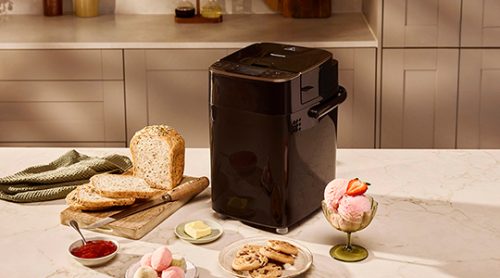
Created for our mini bread & ice cream maker SD-PMC100.


Ingredients
For the tangzhong (flour paste): |
|
| 20 g strong white bread flour | |
| 80 g whole milk | |
For the yeast proof: |
|
| 50 g whole milk | |
| 1 tsp fast action yeast | |
| 1 tsp caster sugar | |
For the main dough: |
|
| Cooled tangzhong | |
| Proofed yeast | |
| 230 g strong white bread flour | |
| 25 g caster sugar | |
| 4 g fine salt | |
| 1 large egg | |
| 33 g unsalted butter | |
| ¾ tsp vanilla bean | |
| For finishing: 1 egg, beaten with 1 tsp milk (egg wash) | |
Steps
|
1
|
In a microwave-safe bowl, whisk together 20 g bread flour and 80 g milk until smooth (no lumps). |
|
2
|
Microwave in 15-second bursts, whisking between each burst, until the mixture thickens to a very thick pudding-like paste (~45-60 seconds total). It should hold its shape when the whisk is lifted. |
|
3
|
Cover with cling film touching the surface and set aside to cool to room temperature (~20 min). |
|
4
|
Warm 50 g milk to lukewarm (~35°C). Test: it should feel neutral on the inside of your wrist — not warm, not cold. If it feels warm at all, let it sit for 5 minutes. |
|
5
|
Stir in 1 tsp fast action yeast and 1 tsp of the caster sugar (taken from the main dough quantity). |
|
6
|
Wait 10 minutes. You should see a foamy, bubbly cap form on the surface — this confirms your yeast is alive and active. If no foam appears after 10 minutes, your yeast is dead or the milk was too hot: discard and start over with fresh yeast at a cooler milk temperature. |
|
7
|
Add to the bread maker pan in this order: cooled tangzhong, proofed yeast mixture, 1 egg, 230 g bread flour, 25 g caster sugar, 4 g salt, and optional vanilla or orange zest. |
|
8
|
Select Menu 21 (Bread Kneading) and set the timer to 20 minutes. Press start. |
|
9
|
After 20 minutes, the dough should be tacky, slightly rough, and beginning to feel elastic. |
|
10
|
Add 33 g softened butter in small cubes, distributed around the dough. |
|
11
|
Select Menu 21 (Bread Kneading) again, timer set to 15 minutes. Press start. |
|
12
|
After the second knead, the dough should be smooth, glossy, and stretchy. It will still be soft and slightly tacky. This is correct for brioche. |
|
13
|
Cover the dough loosely inside the bread pan with lightly oiled cling film. Select Menu 22 (Rise) and set to 90 minutes. |
|
14
|
After 90 minutes, check: the dough should have visibly doubled and feel pillowy when gently pressed. If it has not doubled, extend Menu 22 another 30 minutes, or transfer the dough to a lightly oiled bowl, cover, and place in the oven with just the light on (no heat) for another 60 minutes. If the dough has more than doubled, gently deflate and reshape. |
|
15
|
Turn dough out onto a lightly floured surface. Deflate gently and divide into 6 equal pieces (~75 g each). Weigh for accuracy. |
|
16
|
Shape each piece into a smooth ball by tucking the edges underneath and rolling on the counter under a cupped hand. |
|
17
|
Place on a parchment-lined baking tray, spaced 5 cm apart. Cover loosely with lightly oiled cling film. |
|
18
|
Rise at room temperature for 45-60 minutes, until visibly puffy and nearly doubled. |
|
19
|
Preheat oven to 180°C (fan) / 200°C (conventional). |
|
20
|
Brush buns gently with egg wash. |
|
21
|
Bake for 9-12 minutes, until deeply golden. Internal temperature should read 88-92°C if you have a thermometer. |
|
22
|
Cool on a wire rack for 15 minutes before serving. Best eaten day-of, or freeze for later. We recommend serving these with our espresso sorbet topped with freshly whipped cream. |

 Loading...